All About BYD's Megawatt Flash Chargers: 400 km in 5 Minutes and 15,000 Stations Coming
September 10, 2025•13 min read
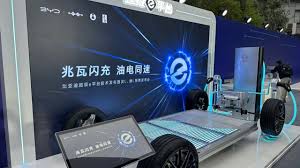

All About BYD’s Megawatt Flash Chargers: 400 km in 5 Minutes and
15,000 Stations Coming
Electric vehicle charging has long been a sticking point for EV adoption. While battery
technology continues to evolve, charging times remain a barrier for drivers used to five-minute
gas station visits. That’s why
BYD’s new “Megawatt Flash Chargers”, capable of delivering 400
kilometers of range in just five minutes, represent a seismic leap not just for the company, but
for the entire EV ecosystem.
China’s largest EV maker isn’t stopping there. BYD has announced plans to roll out 15,000 of
these ultra-fast chargers nationwide, reshaping charging expectations and infrastructure
design.

How Fast is “Megawatt” Fast?
The headline figure,
400 km in 5 minutes, translates to a power output of 1 megawatt (1,000
kW). To put this in perspective:
Charger Type
Peak Output
Typical Charging Speed
Tesla V3 Supercharger
250 kW
~290 km in 15 minutes
Tesla V4 Supercharger (2025)
500 kW
~350 km in 10 minutes
Current High-Speed CCS (Europe)
350 kW
~300 km in 12 minutes
BYD Megawatt Flash Charger
1,000 kW
400 km in 5 minutes
This makes BYD’s charger four times as powerful as today’s common fast chargers and twice as
fast as Tesla’s latest rollout. It effectively narrows the gap between filling a gas tank and
recharging an EV, a psychological barrier many consumers cite as a reason for not switching.

The Technology Behind the Speed
BYD’s innovation isn’t just about pushing more current into the car. To achieve megawatt-level
charging safely and reliably,
several engineering breakthroughs are at play:
1. Advanced Cooling Systems – High-current charging generates substantial heat. BYD
developed next-gen liquid-cooled cables and connectors to manage thermal load
without making cables unwieldy.
2. Energy Storage Buffers – Each charging station incorporates built-in battery storage.
This avoids massive spikes in grid demand during rapid charging sessions, enabling
deployment even in areas with moderate electrical infrastructure.
3. High-Efficiency Power Electronics – BYD’s proprietary silicon carbide (SiC) power
modules improve efficiency and handle higher voltages with minimal energy loss.
4. Smart Battery Communication – Vehicle-to-charger protocols dynamically adjust power
flow to protect the car’s battery while maintaining ultra-fast charging speeds.
These advances reflect BYD’s position not just as an automaker, but as a vertically integrated
technology company – producing batteries, power electronics and complete vehicles in-house.
The Scale of BYD’s Rollout
BYD isn’t piloting a few showcase stations; it’s launching a nationwide megawatt network:
• Total stations planned: 15,000

• Partners: Xiaoju Charging (10,000 stations), LongShine (5,000 stations)
• Current operational: Over 500 stations across 200 Chinese cities
• Timeline: Full deployment expected within 3–4 years
This rollout dwarfs Tesla’s expansion rate in China and rivals the combined efforts of several
traditional charging networks. Crucially, BYD’s network isn’t exclusive to its own vehicles – it’s
designed for open access, allowing other EV brands with compatible high-voltage architectures
to use it.
Impact on EV Design and Ownership
Megawatt charging doesn’t just benefit charging stations – it’s reshaping how electric vehicles
are designed and marketed. With the ability to add 400 kilometers of range in just five minutes,
automakers no longer need to rely on oversized battery packs to ease range anxiety. This allows
them to use smaller and lighter batteries, which in turn reduces overall vehicle weight. The
result is better handling, improved energy efficiency and lower production costs.
This also means manufacturers can pass some of those savings on to consumers, potentially
making EVs more affordable. Most importantly, it changes the long-distance travel experience.
With chargers this fast,
an EV road trip will feel much closer to refueling a gasoline vehicle – a
quick stop instead of a planned half-hour break.
BYD’s upcoming models, built on its latest e-Platform, are designed to fully take advantage of
these chargers. High-end sedans and SUVs will handle near-megawatt charging rates, while

even budget models will see significant improvements in how quickly they can get back on the
road.
BYD vs. Tesla: The Charging Arms Race
Tesla has long held an infrastructure advantage with its Supercharger network, but BYD’s
initiative threatens to shift the balance – particularly in China:
• Power Output: BYD’s 1 MW eclipses Tesla’s 500 kW V4 Superchargers.
• Deployment Speed: BYD’s partnership-driven rollout could surpass Tesla’s station count
within China by 2026.
• Ecosystem Integration: Unlike Tesla’s once-proprietary approach, BYD embraces cross-
brand compatibility, aligning with broader CCS and GB/T standards.
Tesla is expected to respond with megawatt-capable updates, but BYD’s scale and domestic
market dominance provide a strong head start.
Overcoming Challenges: Grid and Safety Concerns
Delivering one megawatt to a single vehicle in minutes is no small feat and it raises legitimate
questions:
1. Grid Load: Simultaneous high-power sessions could strain local grids. BYD’s battery-
buffered stations address this, storing energy during low-demand periods for rapid
bursts.
2. Connector Durability: Repeated megawatt transfers put stress on cables and
connectors. Liquid cooling and robust materials are essential for long-term reliability.
3. Battery Longevity: Fast charging can degrade batteries faster. BYD’s next-gen cells are
designed for high-rate charging with minimal capacity loss, using advanced lithium-iron-
phosphate (LFP) chemistries and improved thermal management.
With these mitigations, BYD argues that megawatt charging is not only feasible but sustainable.
What This Means for Drivers Outside China
While BYD’s rollout is focused on China initially, megawatt-level charging technology won’t stay
confined to one market. The company plans
to bring compatible stations to parts of Europe by
2027, aligning with its growing EV sales there. In North America, expansion is slower due to
differing charging standards like CCS and NACS, but pilot projects are already under discussion.
Other players aren’t standing still – European energy providers and U.S. startups are actively
studying BYD’s architecture, with an eye on replicating or licensing the technology. Within five

years, charging an EV in five minutes could be a common experience in major markets around
the world.
A New Era for EV Charging
BYD’s megawatt flash chargers aren’t just another incremental improvement – they’re a
transformative leap that addresses one of the last major barriers to mass EV adoption: charging
time. By deploying 15,000 stations capable of adding 400 kilometers of range in five minutes,
BYD is setting a new standard for speed, convenience and infrastructure scale.
For drivers, it means EV ownership will feel far less like a compromise and more like a clear
upgrade from internal combustion. For the industry, it signals a charging arms race that will
spur innovation globally. And for BYD, it’s a strategic move that strengthens its already
formidable lead in the world’s most competitive EV market.
