VW's H1 2025 EV Boom with 47% Growth in BEV Deliveries. What's Fueling the Momentum?
August 28, 2025•14 min read

VW’s H1 2025 EV Boom with 47 % Growth in BEV Deliveries. What’s
Fueling the Momentum?
Volkswagen Group has delivered a standout performance in the first half of 2025: 465,500 BEVs
shipped worldwide – a 47 % year-over-year increase compared to H1 2024. This explosive
growth didn’t merely save face – it redefined Volkswagen’s trajectory in the electrification era.
BEVs now account for 11 % of total deliveries, up from 7 % just a year ago.
But this isn’t just about raw numbers. It’s about how VW is rewriting its strategy, leveraging
new models, expanding infrastructure and navigating geopolitical headwinds. Let’s explore
what’s behind the brands’ electric momentum – and what challenges lie ahead.

Europe Leads the Charge, U.S. Gains Ground, China Slows
Markets are moving at different speeds and
Volkswagen’s EV growth mirrors that. Here's a
regional breakdown:
Region
H1 2025 BEV Deliveries
Year-on-Year Change
Share of VW BEV Volume
Western Europe
~347,900
+89 %
~75 %
U.S.
~31,300
+24 %
~7 %
China
~59,400
−34 %
~13 %
Rest of World
~27,000
+55 %
~6 %
Global Total
465,500
+46.7 %
Europe was the standout driver of VW's EV gains – with deliveries nearly doubling compared to
last year, constituting roughly 20 % of all VW deliveries in that market. Meanwhile in the U.S.,
BEV growth continues steadily upward despite policy uncertainty. By contrast, in China, VW’s
historic stronghold, BEV sales dropped 34 %, as domestic competitors continue to take share.
Despite uneven regional demand, VW’s overall group deliveries (across all powertrains) rose
marginally by 1.3 %, to 4.41 million units – which shows EVs are the real growth engine in an
otherwise flat market.

The ID Model Offensive: From ID.3 to ID. Buzz
The backbone of
Volkswagen’s EV push is its ID family – all built on the modular MEB platform,
which simplifies development and production while lowering costs across brands like Škoda,
CUPRA and even Ford. Among the top-selling models in the first half of the year:
• ID.4 / ID.5: ~84,900 units
• ID.3: ~60,700 units
• Audi Q4 e-tron / Sportback: ~44,600 units
• ID.7 / Tourer: ~38,700 units
• Škoda Enyaq (incl. Coupé): ~38,700 units
•
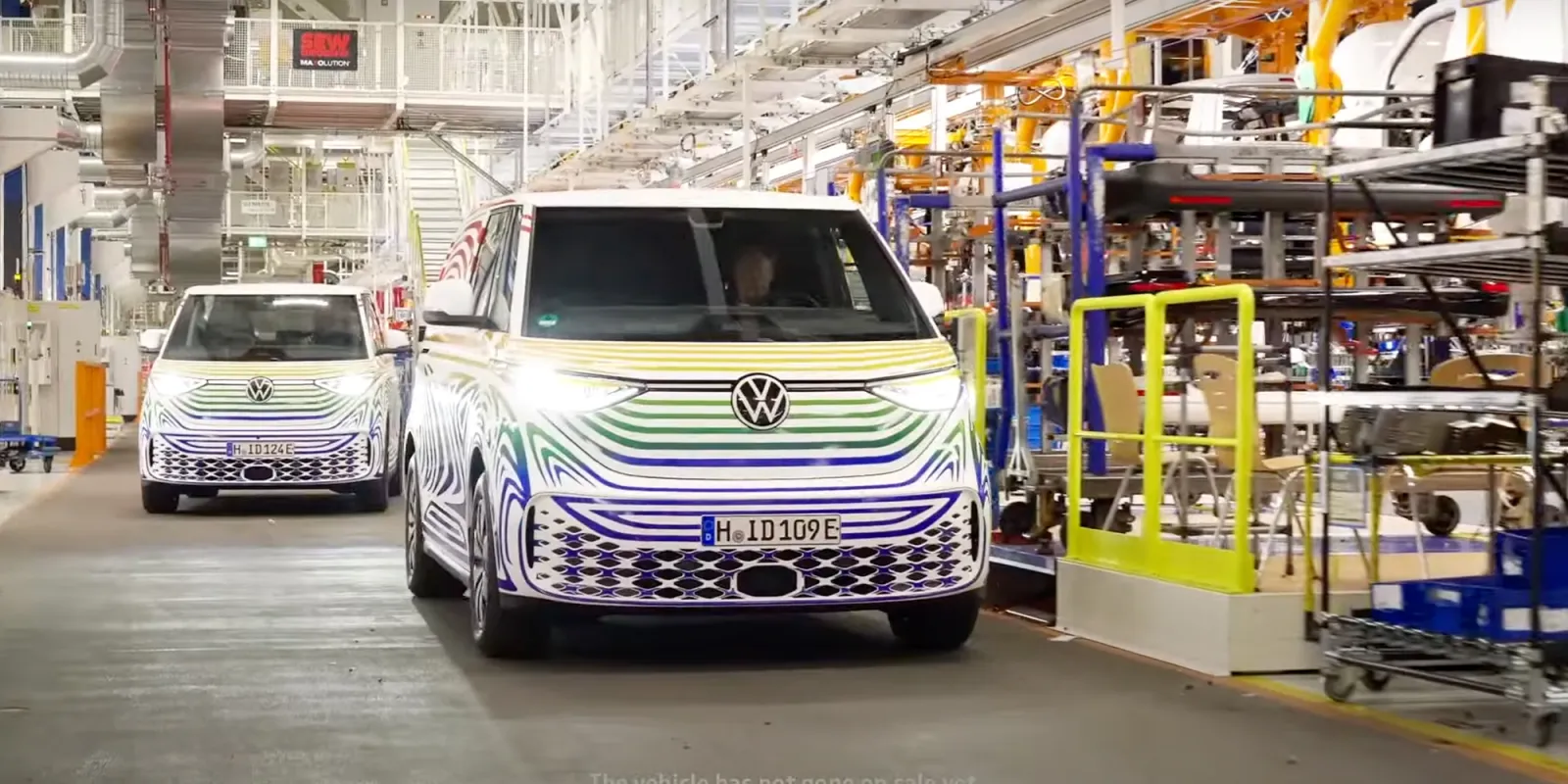
ID. Buzz / Cargo: ~27,600 units
These models cover a wide range of segments, rom compact city cars to SUVs to retro vans,
expanding VW’s reach to different EV customer profiles.
Momentum Built on Strategy: Electrify Europe and Beyond
Volkswagen’s EV strategy isn’t reactive – it’s aggressive and multi-phase. Its “New Auto”
initiative, launched in 2021, committed over €20 billion to battery R&D, electric platforms (like
MEB), software (via CARIAD) and future mobility services.

In China, VW has built manufacturing and R&D capacity through joint ventures and invested in
an e-mobility hub, but rising local competition has eroded its market share from 19 % in 2019
to 14.5 % in 2024.
Meanwhile in Western Europe and the U.S., investments in fast-charging infrastructure via
partnerships with IONITY and Electrify America are making EV ownership smoother. Select ID
models now support up to 200 kW fast charging, reducing domestic “range anxiety”.
Profit Pressure: Tariffs, Costs and Restructuring
Even as EV volumes grow, making money is getting harder. In H1 2025, VW booked a
€1.3
billion hit from U.S. tariffs, prompting it to cut its full-year profit margin forecast from 5.5–
6.5 % to around 4–5 %. Revenue held steady at €158 billion, though net cash flow turned
negative after restructuring costs and tariffs.
The company aims to capture cost synergies by trimming over 35,000 jobs in Germany by 2030,
shifting production (e.g., Golf from Germany to Mexico) and improving platform cost efficiency
by 40 %.
In China and North America, VW’s overall sales declined, by roughly 2% in China and 7% in
North America, due to tariffs and intensifying competition. Handling these regional headwinds
while scaling BEVs remains VW's operational tightrope.
What Lies Ahead: More Models, Lower Prices, Solid-State Hope

Volkswagen still has gasoline-era habits – and untapped EV potential. It plans to launch over 30
fully electric models by 2030, including more affordable small EVs, high-performance GTX
variants and most…an electric-only ninth-generation Golf slated later this decade. Upcoming
models like the ID.2 (€25K starting price) and ID.1 (~€20K) aim to lower the ownership
threshold further.
On the tech front, VW continues collaborating with QuantumScape and investing in solid-state
battery development – catalytic for longer range, lighter weight and faster charging capabilities.
Walled Challenges: Regulation, Competition and Execution
Several risks could derail or slow VW’s EV momentum:
• Regulatory shifts: The upcoming end of the U.S. federal $7,500 EV tax credit in late 2025
threatens demand momentum, especially for lower-priced models.
• Trade friction: Ongoing U.S.–EU tariff negotiations – and the potential for retaliatory
duties – loom as threat multipliers for VW’s export-heavy brands (Audi, Porsche).
• Local rivals in China: Brands like BYD, NIO and XPeng continue dominating EV shares
and producing compelling alternatives at aggressive price points.
• Execution complexity: Scaling consistent EV quality across brands and regions – while
improving profitability – will test VW’s organizational capabilities.
Why VW’s BEV Surge Matters to the Market and You

Volkswagen’s electric acceleration isn’t just another sales report – it’s a statement: a former
diesel titan is transforming into a global EV leader. Here’s why it matters:
• For consumers, more VW EV availability (especially affordable models) translates into
greater choice. Charging infrastructure, paired with broader model reach, becomes a
viable mainstream value proposition.
• For rival automakers, VW’s cost curve reductions through platform sharing and
continued pushdown of EV pricing are intensifying competitive pressure across
segments.
• For investors, robust EV volume growth, even while margins shrink, signals VW’s deep
commitment to long-term positioning, with the understanding that profitability may
follow volume at scale.
VW’s 47 % year-over-year jump in BEV deliveries, and resulting leap to 11 % of total volumes, is
more than just a jump in sales. It’s evidence of a purposeful reinvention. From expanding EV
lineups and infrastructure investments to tackling cost structures and preparing for regulatory
change, Volkswagen is not just racing toward the future – it’s shaping it.
